

Research behind mCLASS Math
—
Based on decades of research on the best practices in math, mCLASS® Math uses reliable and valid measures to identify students needing additional support. Teachers can make informed instructional decisions with instant recommendations for small-group and individualized instruction.
The mCLASS Math K–5 assessment system provides educators with reliable and valid measures to identify students needing additional support in mathematics and to inform instructional decisions.
Evidence supporting the psychometric quality of the assessment uses the technical standards outlined by the National Center on Intensive Intervention (NCII) and state requirements for screening measures.
Valid and reliable assessments
—
Through its groundbreaking reporting and empirically established cut scores for risk, mCLASS Math’s asset-based approach helps pinpoint students’ strengths and areas of growth for instructional targets. mCLASS Math has undergone rigorous psychometric validity studies and is backed by:
- The latest iteration of curriculum-based measurement tools, a state-of-the-art approach for efficiently assessing students’ mathematical thinking.
- Careful consideration of best practices for reliability, validity, determination of risk, and sensitivity to student learning.
- Measures validated for dyscalculia screening.

Meet our advisors and research team.
—
Our development team at Amplify is a dedicated group of classroom veterans, school leadership experts, and world-class math researchers who put decades of knowledge about assessment best practices and mathematical pedagogy into a program designed to support the K–8 math classroom.

Sandra Pappas, Ph.D.
Director, Efficacy and Impact at Amplify

Patrick Callahan, Ph.D.
Head of Measurement and Sensemaking at Amplify

Jason Zimba, Ph.D.
Head of Academic Pedagogy
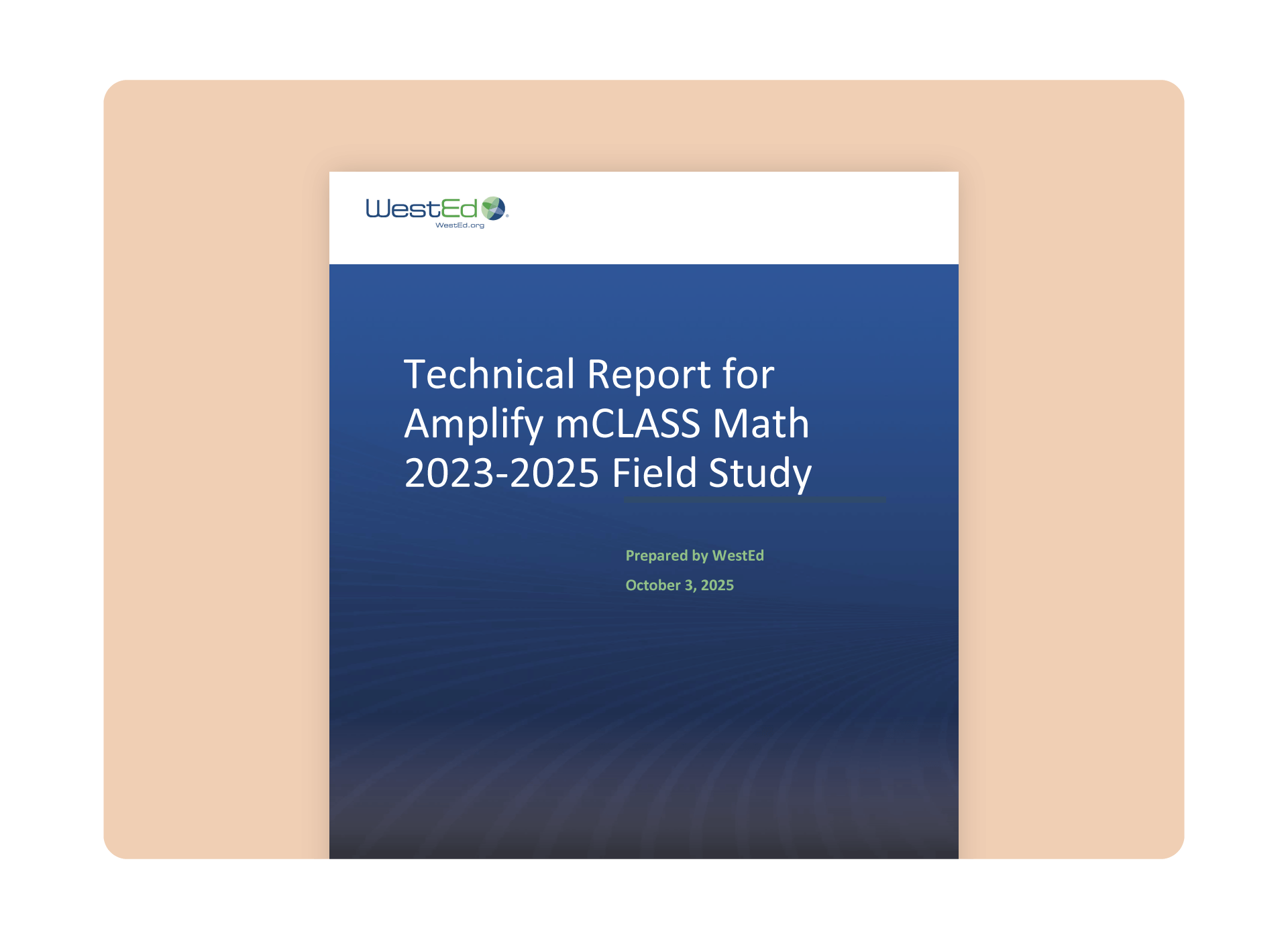
Rigorous psychometric design and validation
—
Every item, cut score, and diagnostic tracking pathway inside mCLASS Math has undergone intensive psychometric evaluation. Our blueprint content and item development process culminated in an extensive Item Calibration Study. Utilizing Classical Test Theory (CTT), Item Response Theory (IRT), and Differential Item Functioning (DIF), we evaluated item quality, discrimination, and difficulty across grades K–8 to guarantee that our predictive risk indicators are highly accurate, valid, and completely equitable.